
Seeing Fields in a New Light: An Introduction to Radar for Agriculture
A Satellite's-Eye View of Our Farms
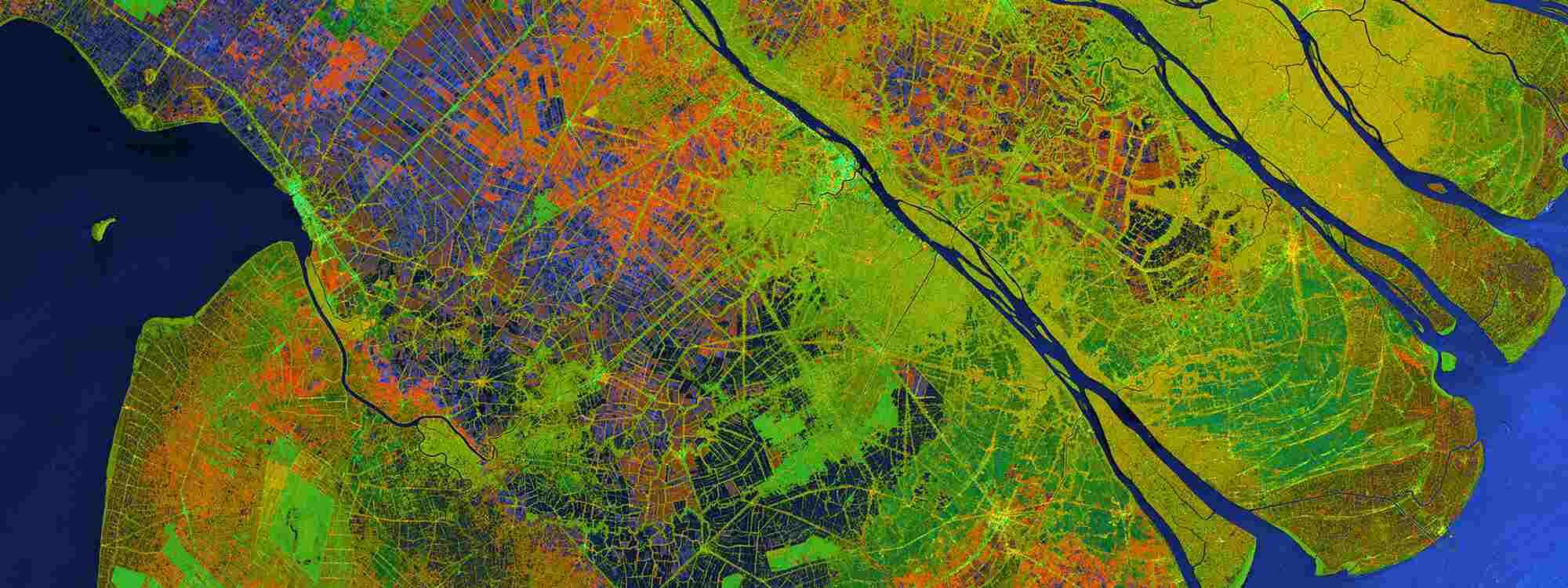
Imagine being able to check on crops across thousands of acres, at any time of day, even when it's cloudy or raining. This isn't science fiction; it's the reality for scientists using special satellites equipped with "radar vision." This technology, called Synthetic Aperture Radar (SAR), allows us to monitor farms around the clock, giving us a powerful tool to ensure the health of our food supply.
This guide will demystify three different "flavors" of radar used for Earth observation—X-band, C-band, and L-band. We will explore how each one provides a unique view of crops and explain why choosing the right flavor is the key to understanding everything from corn growth to soil moisture.
1. What is Radar and Why is it a Farming Superpower?
Synthetic Aperture Radar (SAR) is an active remote sensing technology. Think of it like a bat's echolocation, but on a massive scale. A satellite sends out its own microwave signal towards the Earth's surface and then "listens" for the reflection that bounces back. By analyzing the properties of that reflected signal, scientists can create detailed images of the ground below. This technology has two primary "superpowers" that make it incredibly valuable for agriculture:
- Always-On Monitoring: Because SAR is an "active" sensor—meaning it provides its own "light" in the form of microwave pulses—it isn't dependent on the sun. This means they can capture clear images through clouds, smoke, and even at night—conditions that would render a normal camera (like those on optical satellites) useless.
- Seeing More Than Meets the Eye: SAR goes beyond a simple picture. The radar signals are sensitive to physical properties that we can't see with our eyes, such as the roughness of the ground, the moisture in the soil, and the physical structure of a plant's leaves and stalks.
Not all radar is the same, however. The specific "flavor" of the radar signal determines exactly what it can see.
2. The Flavors of Radar: Understanding Wavelengths with an Analogy
The key difference between X, C, and L-band radar is their wavelength. The length of the microwave signal determines how deeply it can penetrate a crop canopy before bouncing back. To make this simple, imagine you are standing in front of a large, leafy tree and you have three different types of balls to throw at it: a pebble, a tennis ball, and a basketball.
- X-Band (The Pebble): This radar has the shortest wavelength. Like a tiny pebble, it doesn't have much momentum and will bounce off the very first thing it hits—the outermost leaves on the tree. It gives you a great picture of the very top layer of the crop canopy.
- C-Band (The Tennis Ball): This is a medium wavelength. Like a tennis ball, it has enough force to push past the top layer of leaves and interact with the thicker branches and overall structure of the canopy. It gives you a sense of the plant's general size and shape.
- L-Band (The Basketball): This radar has the longest wavelength. Like a heavy basketball, it can pass through most of the leaves and branches to interact with the main trunk of the tree and even the ground below. It provides the deepest penetration, revealing the plant's core structure and the soil conditions.
This simple concept is summarized in the table below:
| Radar Band | Wavelength & Penetration | Tree Analogy |
|---|---|---|
| X-Band | Short (~3 cm) Low Penetration |
Bounces off the outermost leaves (like a pebble). |
| C-Band | Medium (~6 cm) Moderate Penetration |
Hits the main branches within the canopy (like a tennis ball). |
| L-Band | Long (~20 cm) High Penetration |
Passes through leaves to hit the trunk and ground (like a basketball). |
This difference in penetration is what makes each radar band a specialized tool for looking at different types of crops.
3. Putting Radar to Work: Matching the Band to the Crop
The best radar band to use for monitoring a field depends entirely on the physical structure of the crop being grown. A prime example of this can be seen in research on corn and soybeans, which have very different physical structures.
Seeing Corn
Corn is a tall plant with a thick, dominant stalk and large leaves. To understand its health and total size (biomass), you need to measure its primary structure.
This is where L-band radar excels. Studies show that L-band signals have an exceptionally high correlation (r = 0.90–0.96) with corn's Leaf Area Index (LAI), a key measure of plant growth that quantifies the total leaf area in a given ground area. Tying this back to our analogy, the long-wavelength "basketball" of the L-band penetrates the leafy canopy and interacts directly with the thick stalk. Since the stalk's size is directly related to the overall size of the corn plant, L-band gives the most accurate assessment of its total biomass.
Seeing Soybeans
A soybean plant has a very different structure. It is much bushier, with a dense, leafy canopy that makes up most of its volume. Its stalk is much less significant compared to the overall canopy.
For this reason, C-band radar is more effective for monitoring soybeans. Research indicates a stronger correlation (r = 0.58-0.80) between C-band signals and the LAI of soybeans. The medium-wavelength "tennis ball" of the C-band interacts effectively with the dense, leafy part of the plant. Since the canopy is the dominant feature of a soybean plant, the C-band provides the best measurement of its health and density.
The ability to choose the right tool for each crop gives farmers and scientists a powerful advantage in managing agriculture sustainably.
4. The Big Picture: Why Choosing the Right Radar Matters
Selecting the right radar band is more than just an academic exercise; it has real-world benefits for making farming more efficient and environmentally friendly.
- 1. The Right Tool for the Job: Scientists and farmers can select the perfect radar band to answer specific questions. If they need to measure the biomass of a cornfield, they use L-band. If they want to monitor the density of a soybean canopy, they use C-band. This targeted approach provides more accurate and actionable information.
- 2. Early Warning System: By consistently monitoring crops with the right radar, it is possible to detect the early signs of stress from drought or disease long before they become visible to the human eye. This allows farmers to intervene precisely when and where it's needed, saving crops that might otherwise be lost.
- 3. Smarter, More Sustainable Farming: This detailed information is the foundation of precision agriculture. It enables farmers to apply resources like water and fertilizer with incredible accuracy—a practice known as Variable Rate Technology. For example, a study in the Midwest United States found that variable rate nitrogen application increased corn yields by 6-8% while simultaneously reducing nitrogen use by 10-15% compared to uniform application. This not only improves crop yields but also reduces waste, saves money, and minimizes environmental impact.
5. Conclusion
From space, our planet's farms are a complex patchwork of different crops, each with its own unique structure and needs. The different "flavors" of radar—X, C, and L-band—are like specialized lenses, allowing us to see these agricultural landscapes with astonishing detail. By understanding whether we need a pebble, a tennis ball, or a basketball to measure a crop, we can monitor our food supply more effectively than ever before, helping to create a more efficient, resilient, and sustainable future for agriculture.